Where does the money come from?
Fannie Mae's real name, Federal National Mortgage Association, was a deal to jump start mortgage lending. It is a corporation that was privatized in 1968 and currently trades on the New York stock exchange. Its mission (among others) is to guarantee mortgages for a fee. It also sets a ceiling for the size of a mortgage it will back. The limit is half again higher in Hawaii, Alaska and Guam than on the U.S. mainland.
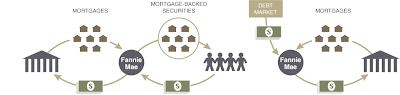
Fannie Mae takes mortgage loans from banks, in order to repackage them in the form of mortgage-backed securities.
Those mortgage-backed securities are sold to investors, and Fannie Mae guarantees that the loans will be repaid. Fannie Mae also borrows money from the debt markets usually at a rate much lower than other banks, and uses it to buy mortgages it holds as its own investments.
By buying these loans, Fannie Mae injects new money into the housing economy.
Current Problems
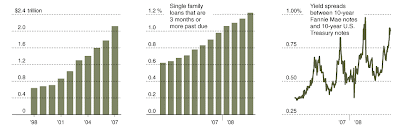
Guaranteed Mortgages
Fannie Mae's exposure to the housing market has soared. Its outstanding guaranteed mortgages tripled from 1998 to 2007.
Delinquency Rates
The delinquency rate on Fannie Mae mortgages is rising. This increases the chance that the company will have to make good on its guarantees.
Borrowing Costs
Borrowing costs are volatile and rising, reflecting investor concerns about Fannie Mae's health.
What Is the Reach of the Problems?
Fannie Mae and Freddie Mac (a competing mortgage lender) own or guarantee about half of the nation's $12 trillion mortgage market.
Housing Markets
They provide the capital that banks use to write new loans. If Fannie Mae and Freddie Mac stop buying loans, banks may stop making new loans, freezing the United States housing market.
These mortgage operations provide stability and liquidity to the mortgage market. If it is harder for them to borrow money, mortgage interest rates will rise.
Financial Markets
Virtually every Wall Street bank and many overseas financial institutions, central banks and investors do business with Fannie Mae and Freddie Mac.

What Are the Consequences of a Government Bailout?
Paying for Losses
A bailout would potentially put taxpayers on the hook for billions to offset Fannie's and Freddie's losses.
National Debt
It would most likely make it more expensive for the United States government to borrow money in the future, since the government's potential obligations, which currently stand at about $9 trillion, would rise by an additional $5 trillion.
Investors Suffer
Shares of Fannie and Freddie would probably be worth little or nothing.
-----------------------------------------------------------------------------------------------------------------------------
Sources: New York Times, Fannie Mae; Office of Federal Housing Enterprise Oversight; Bloomberg
from The Porch…

Mike B. Class Star®


